
Every SEO professional has had the same fantasy at some point: knowing which topics are going to blow up before they blow up. Publishing the definitive resource on a query six weeks before search volume spikes. Being the site that captures the wave rather than chasing it after it’s already crested.
Most people treat this as a pipe dream. A nice idea in theory, practically impossible in execution. And for traditional SEO approaches, that’s more or less accurate — the tooling doesn’t support meaningful trend prediction, only trend reaction.
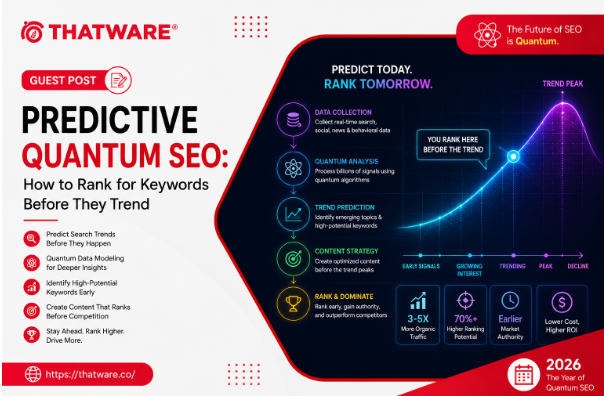
Predictive quantum SEO makes this fantasy substantially more realistic. Not through some magical algorithm that sees the future, but through probabilistic modeling of search behavior that identifies emerging intent patterns while they’re still small enough to get ahead of.
Why Traditional Trend Research Fails
The go-to tools for trend identification in traditional SEO — Google Trends, keyword research platforms, search volume data — all have the same fundamental limitation: they’re measuring the past.
By the time a query shows up with significant search volume in a keyword tool, the trend has already arrived. The competitors who were paying attention noticed it simultaneously. You’re not getting ahead of the market; you’re joining a race that’s already started.
Worse, the most valuable search territory often exists at the intersection of concepts rather than in single-keyword spikes. A new regulatory change affects a product category. A cultural moment shifts consumer language around a service. A technology advancement makes a previously niche topic suddenly relevant to a broad audience. These intersectional trends are nearly invisible in traditional keyword data until they’ve fully materialized.
What’s needed is something that models the probability distribution of future search behavior rather than measuring current search behavior. That’s a very different kind of analysis.
How Predictive Quantum SEO Works
The predictive layer of a quantum SEO approach is built on several interconnected analytical frameworks, each drawing on quantum-inspired probabilistic thinking.
Semantic field monitoring — Rather than tracking specific keywords, predictive quantum SEO monitors the semantic fields around topics relevant to your domain. A semantic field is the network of concepts, entities, and relationships that surround a topic. When this field starts showing unusual patterns — new entity associations, emerging co-citation clusters, increased signal from specific query types — it indicates that search behavior in this space is about to shift.
Weak signal amplification — This is probably the most distinctive capability. Quantum-inspired analysis is particularly good at identifying weak signals in noisy data — small but statistically meaningful patterns that conventional analysis would filter out as noise. In practice, this means detecting query patterns that are just beginning to emerge, months before they’d show up as significant volume in standard keyword tools.
Cross-domain correlation modeling — Search trends don’t emerge from nowhere. They’re driven by events, conversations, technologies, and social dynamics happening in the broader world. Predictive quantum SEO correlates signals from academic research, patent filings, industry news, social conversation, and regulatory announcements with search pattern data to identify likely future query emergence.
Probability-weighted content roadmapping — Rather than deciding which content to create based on current search volume, the predictive model generates probability-weighted forecasts of future query value and prioritizes content production accordingly.
Getting Practical: What This Looks Like
Let me ground this with a concrete example of the kind of predictive edge this approach creates.
Imagine you’re in the healthcare technology space. Traditional keyword research shows you the high-volume terms in your category right now — EHR software, telehealth platforms, medical billing solutions. You optimize for these, you produce content around them, and you compete with every other company in your space for the same rankings.
Now imagine Predictive Quantum SEO monitoring picks up something different: a cluster of academic papers discussing a new approach to clinical documentation automation is generating unusual citation patterns. Related regulatory guidance is in draft form at the FDA. Three healthcare IT conferences in the past 60 days have featured the topic prominently. The query terms associated with this concept are currently low-volume — maybe a few hundred searches per month globally.
The predictive model flags this as a high-probability emerging trend and recommends producing comprehensive content now. Six months later, the regulatory guidance finalizes. The query cluster explodes to tens of thousands of monthly searches. Your site is already the authoritative resource. Competitors who are just discovering the topic through their keyword tools are starting from zero.
That’s the actual value of predictive quantum SEO — not a marginal improvement in your current keyword rankings, but structural positioning ahead of where the market is moving.
The Technical Machinery Underneath
For those who want to understand the mechanics, predictive quantum SEO’s forecasting capability is built on a few key technical components:
Temporal sequence modeling — Machine learning models trained on historical search trend data to identify patterns in how trends emerge. What does a topic look like in the data 3 months before it trends? 6 months before? These pattern signatures become detection templates.
Knowledge graph evolution tracking — Google’s Knowledge Graph is not static. New entities are added, new relationships between entities are established, and the graph’s topology changes over time. Tracking these changes provides leading indicators of what topics Google is beginning to treat as significant.
Probabilistic intent modeling — Using quantum-inspired probability amplitude calculations to model the likelihood that a given intent pattern, currently low-volume, will experience significant growth based on external signal clusters. This is fundamentally Bayesian reasoning, structured by quantum probabilistic frameworks.
Semantic velocity measurement — Tracking not just whether a topic is being searched, but how the velocity of semantic expansion around a topic is changing. A topic that’s growing its semantic neighborhood rapidly is on a trajectory to become important in search, even if absolute volume is still modest.
Common Mistakes When Implementing Predictive SEO
A few pitfalls that consistently emerge when organizations try to build predictive capabilities into their SEO programs:
Chasing too many signals — The value of predictive modeling comes from focusing on the signals with the highest predictive validity for your specific domain, not monitoring every possible data source. More signals don’t equal better predictions — they often just add noise.
Publishing prematurely shallow content — The point of getting ahead of a trend is to be the authoritative resource when the topic peaks. Publishing thin placeholder content weeks early defeats the purpose. The content produced for predicted trends needs to be comprehensive from the start.
Ignoring the content quality investment — Being early doesn’t help if competitors can easily out-rank you when the topic scales up. Predictive quantum SEO requires pairing the prediction capability with genuine content quality and semantic depth.
Failing to update as the topic evolves — Emerging topics evolve as they mature. Content published early needs ongoing updates to remain comprehensive as the semantic space around the topic fills in.
Building a Predictive Content Calendar
Predictive SEO with quantum algorithms ultimately needs to manifest in a practical workflow: a content calendar that’s built around predicted opportunity rather than current keyword volume.
The structure of this calendar looks different from a traditional editorial calendar. Instead of monthly keyword targets, it uses probability-weighted topic windows — periods during which specific topics are forecast to experience significant search volume growth, with confidence intervals attached.
High-confidence predictions (strong signal clusters, short time horizon) get near-term content production slots with comprehensive resource investment. Medium-confidence predictions get placeholder slots with preliminary research allocated. Low-confidence signals get monitoring without production commitment yet.
This approach necessarily involves accepting some predictions that don’t materialize. That’s fine. The expected value of getting the high-confidence calls right — with first-mover advantage in an emerging topic — substantially outweighs the cost of the occasional miss.
The businesses winning in organic search over the next three to five years won’t be the ones reacting fastest to what’s already trending. They’ll be the ones that figured out how to see the trends coming — and built the infrastructure to act on that intelligence before everyone else realized the race had started.